


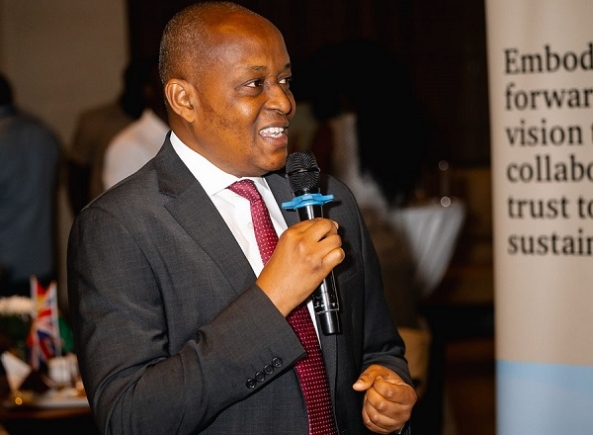
Outgoing PwC Ghana Country Senior Partner, Vish Ashiagbor, has urged businesses to adapt their operations, strengthen commercial relationships, and explore new markets as Ghana’s economy moves toward greater private-sector participation.
He said the economy has reached an “inflection point”, requiring companies to improve execution, access to capital, and operational efficiency rather than rely heavily on government spending to drive demand.
Mr Ashiagbor made the remarks at the Welcome Reception of the three-day UK-Ghana Trade & Investment Summit 2026, organised by the UK-Ghana Chamber of Commerce (UKGCC) under the theme, “A Decade of Trust, A Future Always On: Scaling the UK-Ghana Growth Partnership.” PwC Ghana was the lead sponsor of the reception.
Business shift
Mr Ashiagbor said the event provided an opportunity for businesses, policymakers and other stakeholders to assess the changing business environment and identify opportunities for growth.
He said some businesses might have interpreted slower commercial activity as a sign of weak demand, when in reality companies were adjusting to changes in the economy.
“My view is that things may appear slow, but that is because we are at an inflection point,” he said.
He said the transition meant businesses had to review how they operated and how they positioned themselves for growth.
“There are processes that need to change. There are relationships that need to change. There are new relationships that need to form. There are new markets that need to be explored,” he said.
Interest rates
Mr Ashiagbor also expected the Bank of Ghana’s Monetary Policy Committee to maintain the policy rate, citing recent comments by the Governor and a slight increase in inflation.
“My expectation is that the rates hold because there are emerging risks that require some caution,” he said.
The Bank of Ghana subsequently maintained the policy rate at 18 per cent at its September 24 meeting.
The decision had implications for businesses because the policy rate influenced borrowing costs, investment decisions and the cost of financing expansion, although commercial lending rates did not always move in direct proportion to the policy rate.
Mr Ashiagbor said the gradual move towards a stronger private-sector-led economy was positive, but businesses needed to position themselves to take advantage of the opportunities.
Trade links
UKGCC Executive Director, Adjoba Kyiamah, said the summit was intended to move UK-Ghana relations beyond government engagement towards investment, trade and long-term commercial partnerships.
She said the chamber wanted businesses in both countries to use the relationship to expand their markets and investment opportunities.
“We believe a strong UK-Ghana Growth Partnership must create commercial value in both directions. It must support UK investment into Ghana while enabling competitive Ghanaian companies to expand internationally, using the UK as a launchpad,” she said.
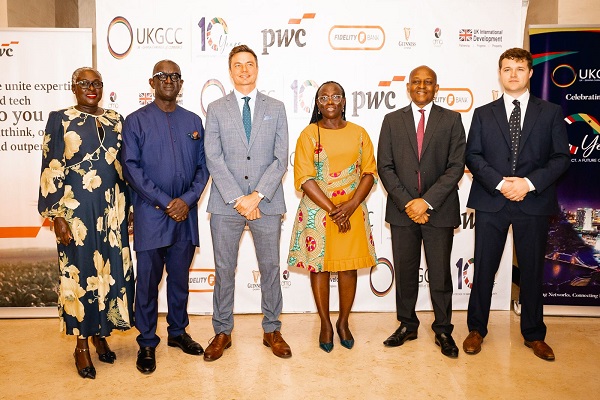
The first day of the summit included discussions with the Association of Ghana Industries on priority investment areas and the PwC-hosted reception.
The second day was scheduled to feature a deal room presenting investment-ready projects from Ghanaian companies and connecting them with prospective investors.
UKGCC said bilateral trade between Ghana and the UK had exceeded £1.6 billion, with the summit seeking to generate further investment and trade opportunities.
Mr Ashiagbor said businesses that strengthened their processes, networks and market reach would be better placed to convert the changing economic environment into investment and revenue opportunities.