


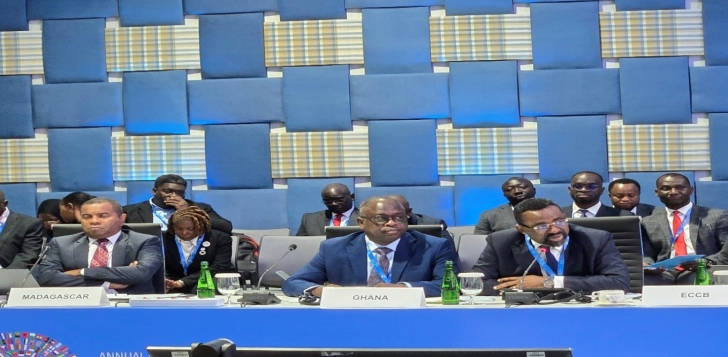
Ghana has endorsed the establishment of a financing facility designed to provide rapid liquidity support to climate-vulnerable economies facing balance-of-payments pressures arising from climate shocks.
The endorsement was also secured from five other countries, including Barbados, Bhutan, The Gambia, Guyana and Papua New Guinea, for the proposed Lifeline Fund, which has an initial capitalisation target of $500 million and a longer-term capital pathway of $1.6 billion.
When operational, the fund is expected to incorporate resilience-focused structural measures to help countries address vulnerabilities that make them more susceptible to future shocks.
As a result, central bank governors from the six countries signed a non-binding statement of endorsement, expressing their interest in participating in the proposed arrangement, which comprises two lending facilities designed to address different dimensions of climate-related economic shocks.
The signing was made at the sixth Vulnerable Twenty (V20) Central Bank Governors Working Group Meeting on the sidelines of the ongoing International Monetary Fund (IMF)/World Bank Annual Meetings in Bangkok, Thailand last Tuesday, October 13.
On Ghana’s side, the meeting was attended by a delegation led by the Governor of the Bank of Ghana (BoG), Dr Johnson Pandit Asiama and the Minister of State for Climate Change and Sustainability, Seidu Issifu.
Predictable financing
Dr Asiama said Ghana was committed to the proposed fund to offer timely, affordable and predictable financing to help prevent climate-related shocks from worsening economic and debt challenges.
He said the fund should work alongside existing Global Financial Safety Net (GFSN) arrangements and other international financing mechanisms, including those of the International Monetary Fund (IMF), while addressing the specific liquidity challenges triggered by climate shocks.
Urging stakeholders to accelerate efforts to establish the fund, he called on development partners to maintain their support and participating countries to fast-track the necessary domestic approval processes.
He stressed that the fund required sufficient and dependable capital, strong safeguards and a sustainable financial framework to ensure it could provide effective assistance to countries affected by climate-related shocks.
He added that close coordination with existing international financing arrangements would be crucial to ensuring the fund complemented ongoing initiatives and avoided duplicating their efforts.
Ghana’s mobilise support
For his part, Mr Issifu said the fund would provide countries with quicker access to financing to respond to climate-related disasters, which often reversed development gains and placed additional pressure on public finances.
He said Ghana had called for countries undergoing debt restructuring not to be excluded from climate financing opportunities.
“If they are taking difficult decisions, these difficult decisions should not exclude them from these opportunities of climate funding,” he said.
The minister said Ghana was expected to make a contribution to demonstrate its commitment, while other strategic partners would be encouraged to support the initial $500 million capitalisation target and its subsequent expansion.
He added that the government was also strengthening climate action through community sensitisation and coordination across ministries and district assemblies to promote environmental responsibility and sustainable development.
Background
The V20 Lifeline Fund is an initiative of the Vulnerable Twenty (V20) Group aimed at establishing a member-owned financial safety net for economies vulnerable to climate change.
It is designed to provide rapid liquidity support to countries facing balance-of-payments pressures following climate-related disasters, helping them respond to emergencies without worsening existing economic and debt challenges.
The proposed fund comprises two lending facilities: the Rapid Resilience Facility, with a maturity of one to three years and the Stabilisation Credit Facility, with a maturity of three to five years.
It has an initial capitalisation target of $500 million and is intended to complement existing international financing mechanisms while addressing climate-induced liquidity needs.
The V20 Group is a coalition of countries, including Ghana, that are particularly vulnerable to the effects of climate change, especially its economic and financial consequences.
Established in 2015, the V20 operates under the broader Climate Vulnerable Forum (CVF), bringing together finance ministers and other policymakers to push for greater international support for countries facing climate-related risks.