


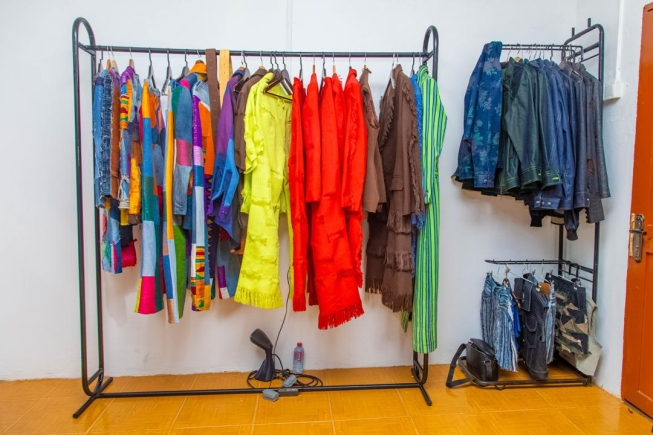
At first glance, the studio in Mamprobi, in the middle of Accra, looks like any other bustling fashion workshop — mannequins draped in half-finished garments, rolls of fabric leaning against walls and the hum of sewing machines in the background. Look closer, however, and the clothes tell a different story.
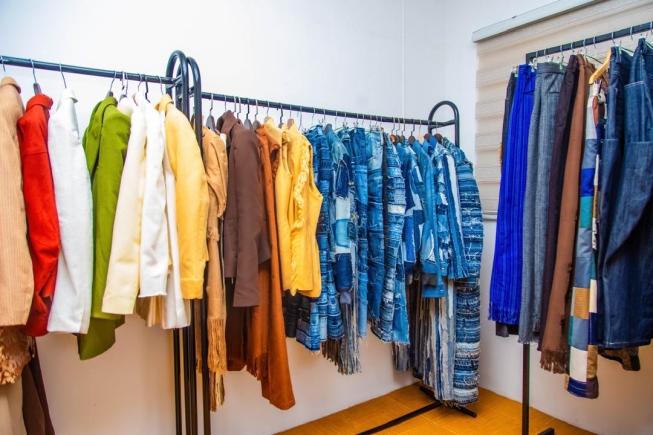
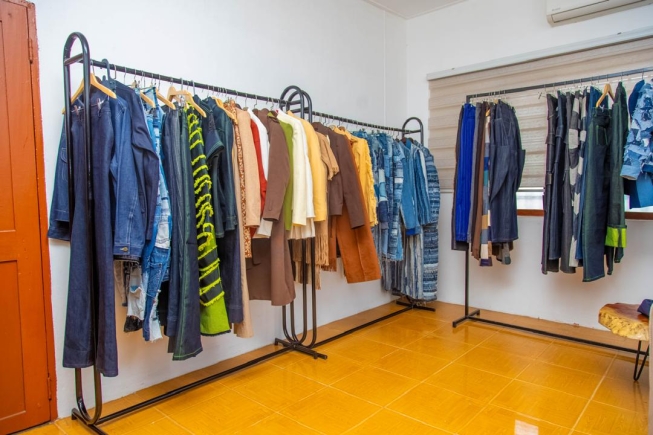
The denim on the rails is not new. It carries the faded marks of previous lives. Waistbands have been removed, inseams taken apart and pairs of trousers stripped down before being reconstructed into something entirely new.
This is Boyedoe, the Ghanaian fashion label that has built an increasingly global reputation around an unlikely proposition: taking materials that others have discarded and giving them a place in luxury fashion. But the journey from a young Ghanaian label to international runways has required more than a distinctive design philosophy.
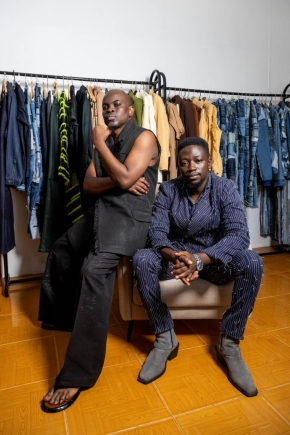
For the founders of the brand, David Kusi Boye-Doe and Nana Kwadwo Akonnor Bekai Duah, one of the biggest turning points came when Boyedoe found a partner capable of opening doors into the global fashion ecosystem. That partner was the African Export-Import Bank (Afreximbank), through its Creative Africa Nexus (CANEX) programme.
Since joining the programme in 2023, Boyedoe has moved from showcasing in Portugal to participating in five seasons at Tranoï in Paris and one in Tokyo, while also staging a runway show in Paris. The story, however, began much closer to home.
The Boy that Do
There’s something about people destined for greatness. In Boyedoe’s case, it appears David was doing the unusual even before he could make his own choices. David is a 100percent Ashanti boy, born and raised in Kumasi. As such, his globally-recognised, Ga-Damgbe surname — Boyedoe — has people scratching their heads. It is an ode to his late father's friend; a man he would never meet. But early on, David was already combining the best of both worlds.
Fashion was not his first choice. “My first love was to be an architect,” he says. But the death of his father changed the trajectory of his life. “There wasn’t the financial means to push me,” he recalls.
So he turned to the market. He began selling second-hand clothes from Kantamanto and shoes from the commercial district, buying pieces and reselling them to bankers and office workers. Soon, however, he realised he could offer more than the clothes themselves.
His customers did not always know how to put the pieces together in the way he imagined, so he began styling them. He started buying clothes for clients and eventually moved into styling grooms for their weddings. “I had a business called Grooms on Point,” he laughs. But working with tailors brought another frustration. “You’d trust a tailor and they’d disappoint you. The suit wouldn’t come out the way you wanted, or there’d be a mistake. So I realised, why don’t I go into it myself?”
That decision took him into formal fashion training. In 2018, he enrolled at the JACCD Design Institute Africa in Accra, under the tutelage of the fashion luminary, Joyce Ababio. “I went in with a clear vision. It wasn’t like, let me just go and do anything,” he says.
His graduation collection would provide an early indication that the vision had potential beyond Ghana. The work caught the attention of Vogue Italy after a photographer discovered it on Instagram and offered to shoot the collection. That photographer was Nana Kwadwo Akonnor Bekai Duah, who would later become Boye-Doe’s business partner. “I trusted him with my pieces, and the pictures were spectacular. From there, we built the brand together,” Boye-Doe says. Boyedoe officially launched in January 2020.
Finding a different lane
By then, David had already identified a crowded segment of the local fashion market. “I knew the traditional Ghanaian market — weddings, birthdays, churches, bright corsets — was saturated. So what could I do differently that nobody was doing?” he explains.
The answer was denim. “Everybody owns a pair of denim. It’s timeless, versatile, and has history,” he notes. But Boyedoe's approach was not simply to reuse old garments. The brand takes denim apart, removing waistbands, inseams and back details before reconstructing the pieces into new material and new silhouettes. “We pick a pair of denim, remove the waistband, the inseam, the back details, and create a whole new fabric out of it. That dress on the mannequin? It came from only the waistbands of hundreds of pairs,” Bekai Duah explains.
The material became a vehicle for a broader design philosophy built around four pillars — sustainability, silhouette, sophistication and sunsum (spirit). That last element is expressed through sunsum, an Akan concept referring to soul or spirit.
For Bekai Duah, who is responsible for the brand's interactions with the outside world, sunsum is the quality that separates technically accomplished designers from those whose work carries an unmistakable identity. “It’s that fraction of a second that takes you across the finish line in a 100-metre dash,” he says. “Everybody’s a top designer, but that small portion coming from the soul, that’s what makes the difference.”
Then came CANEX
The turning point in Boyedoe’s international journey came in 2023, when the fashion house applied to Afreximbank's CANEX programme. The Bank, through CANEX Presents Africa, identifies and supports emerging African fashion designers, providing access to international markets, mentorship and visibility. Boyedoe was selected to participate in Portugal Fashion Week alongside about 20 designers from across Africa. “We submitted our works and got selected. They took us to Portugal Fashion Week, that's 20 designers from all over Africa. We were the only Ghanaian brand that season,” Boye-Doe recalls.
Portugal opened another door. Afreximbank subsequently selected a number of designers for Tranoï, the premier trade show held during Paris Fashion Week. For Boyedoe, the significance of Tranoï was not simply the prestige of being in Paris. It was the people who were there to buy. “Tranoï is where buyers from Harrods, Galeries Lafayette, and other top retail houses come to discover new talent,” Boye-Doe explains. “You hang your pieces on a rack, and buyers come to view, to buy into their shops.”
Boyedoe has now participated in five seasons at Tranoï in Paris and one in Tokyo. Last year, the brand also staged its first runway show in Paris with CANEX support. For a small independent label, the economics of such an undertaking can be prohibitive. “To do an independent show in Paris, you’d spend nothing less than US$250,000 for models, space, production. A model costs €500 for just five seconds on the runway. So, for a small brand, that’s impossible,” Bekai Duah says.
CANEX's support, however, goes beyond covering the cost of a runway. “It’s not the hard cash they give you. They might not hand you physical money, but they pay for your space, your flights, your production. And they require accountability, invoices, documentation. That’s good governance,” Bekai Duah adds. For Boye-Doe, that accountability is part of what makes the relationship valuable. “If you really want to grow, you cannot do it alone,” he says. “Unless you’re doing something illegal, you should be open. Investors need to see what you’re doing, the profits you’re making, before they commit.”
The value of a global credential
The founders believe the most important benefit of CANEX may not be any individual show. It is the portfolio of experience the programme has helped Boyedoe build. “Through CANEX, we’ve built a brand portfolio that we could never have built on our own,” Boye-Doe says. That portfolio increasingly matters when competing for opportunities outside the CANEX ecosystem. “When you apply for competitions like the LVMH Prize, they ask: how many runways have you done? How many countries? Do you have stockists? CANEX gave us those credentials.”
The results are increasingly visible. Boyedoe now has stockists in Ghana, Nigeria, South Africa, Spain and the United States. In February 2025, the brand was named a semi-finalist for the LVMH Prize, one of the fashion industry's most prominent platforms for emerging designers. For a business that began in Ghana, international recognition is becoming less of an aspiration and more of an operating reality.
Still looking homeward
Yet international exposure has also made David more conscious of what Ghana’s fashion industry still lacks. “When we travel to Paris, we often see the South African ambassador, the Nigerian ambassador, at fashion events,” he observes. “But we rarely see the Ghanaian ambassador.” For David, these are missed opportunity not only for Boyedoe but for Ghana. “These are events where the richest people in the world, Vogue editors, top buyers, are in attendance. It would have been a huge opportunity for Ghana’s consulate to engage.”
He is nevertheless optimistic that the attention given to the creative sector will change. “I think the industry is going to be very important. The government is beginning to see that there is a lot of potential in the creative sector, and I believe the attention will grow.”
The next frontier
For now, Boyedoe is looking to convert its international visibility into a more substantial physical and commercial presence. The company wants to establish its first flagship store in Ghana. “We want to open our flagship store in Ghana,” Boye-Doe says. “We’ve only ever been online, albeit on some iconic luxury retail platforms such as Galeries Lafayette,but we want a physical presence where people can experience the brand.”
Beyond Ghana, the next targets are in Asia. “Europe and America are great, but Asia is where the money is today — Japan, South Korea, China,” he says. The brand had been expected to travel to Seoul in September, but the opportunity clashed with London Fashion Week. “The phones are calling.”
The London engagement now forms part of Boyedoe's next chapter, as the brand prepares for London Fashion Week in September 2026. And this is in addition to being selected as a semi finalist for the LVMH Prize. Yet growth, for David, is not ultimately about building the biggest fashion house possible. It is about proving that the success of one African creative can create space for many others. “The bedrock of our hearts is to see a hundred more Boyedoes springing up,” he says passionately. “It’s not all rosy out there, but we see young guys online doing their own thing. If we can shine a light on them, share our experiences and networks, that’s where our legacy lies.”
It is an ambition that sits comfortably with the story of Boyedoe itself. Boyedoe’s influence also extends into fashion as a vehicle for social mobility. The brand was among the Ghanaian fashion houses that participated in the Fashion Expressions: The Stories She Wears, an initiative by Prada Group and the United Nations Population Fund (UNFPA) that provided vulnerable young women with practical fashion skills and industry experience.
The programme combined fashion training with education on sexual and reproductive health and rights, giving participants skills they could use to build livelihoods. The brand may have started by giving discarded materials another life, but its founders increasingly want to do the same for African creative talent — giving promising designers the networks, exposure and opportunities to build businesses of their own.
And while international recognition has become an important part of that journey, Boye-Doe insists it is not the validation that drives him. “We don’t need Western affirmation to feel we’ve arrived,” he says with a quiet smile. “But when it comes, we appreciate it. And we make sure it’s not just about us — it’s about lifting a new Africa that we all want to see, the African we want.”
The interview was conducted at Boyedoe’s fashion base in Mamprobi, Accra.