


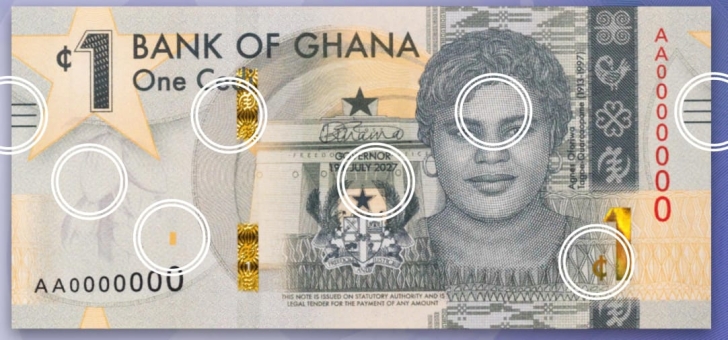
President John Dramani Mahama on Thursday launched the Ghana Cedi Heritage Series at the Bank of Ghana headquarters in Accra, unveiling new banknotes that carry the nation’s history into everyday transactions and placing the legendary Makola market queen, Agnes Oforiwaa Tagoe-Quarcoopome, on the GH¢1 note.
The notes enter circulation on December 1, 2026, and will run alongside the existing series, which remains legal tender.
The ceremony at Bank Square, attended by the Chief Justice, the Governor of the Bank of Ghana, Deputy Governors, Members of Parliament, heads of religious bodies, the diplomatic corps and representatives of the banking industry, marked the most significant redesign of the cedi since the 2007 redenomination. It also served as a prelude to the 2027 Budget, which the Finance Minister presented to Parliament later in the day.
Speaking at the launch, President Mahama traced the cedi’s lineage to the cowrie shell, from which its Akan name derives, and to the gold dust weighed with brass weights in the markets of Salaga and along the coast. He invoked the Adinkra symbol of the two crocodiles sharing one stomach, saying it taught that "whatever either eats nourishes both, so their common survival depends on recognising their shared interests."
"The cedi passes through countless hands. It rests in the palm of the kayayei in Makola and in the hands of the fishermen in Elmina. It is counted by the young seller in Techiman and by the student buying books in Legon, and by the grandmother in Wa helping to pay for her grandchildren’s schooling," the President said. "The cedi knows no political party."
A story told from note to note
Togbe Afede XIV, the Agbogbomefia of the Asogli State, who together with the Ga Mantse, King Tackie Teiko Tsuru II, and other sub-chiefs launched the Cedi App at the event, said the new series was "designed to connect us to our heritage, the heritage that we all share, our history, designed to give us a sense of ownership, designed to give us a sense of unity. And of course, to inspire."
Dominic Owusu, Director and Head of the Currency Management Department at the Bank of Ghana, walked the gathering through the narrative woven into each denomination, beginning with the GH¢1 note and its portrait of Agnes Oforiwaa Tagoe-Quarcoopome. "The story of the heritage series starts from commerce," he said. "She is the first market woman to support Ghana’s independence, and also to open a bank account in the then Standard Bank." The back of the note bears the ceiling of Makola Market and the Adinkra symbol "Gye Nyame," signifying prosperity through promise.
The GH¢2 note features Cardinal Peter Poreku Dery, representing the Christian fraternity, with the Great Mosque of Larabanga on the reverse. The GH¢5 carries the portrait of James Emman Kwegyir Aggrey, linked on the back to Achimota School. The GH¢10 honours the judiciary with the Supreme Court, the GH¢20 celebrates the arts with the National Theatre and the "Duafe" symbol, and the GH¢50 features Theodosia Salome Okoh, designer of the national flag, with Jubilee House on the reverse. The GH¢100 bears the portrait of Osagyefo Dr Kwame Nkrumah at the Peace Education Centre, while the GH¢200 presents Nkrumah’s mausoleum and the Adinkra symbol signifying authority and leadership. "When I say one Ghana cedi, I see Agnes, and of course, she’s associated with Makola Market," Mr Owusu said. "This is my memory."
Security, durability and a new legal order
Governor Dr Johnson Pandit Asiama said the series incorporates enhanced security features to strengthen protection against counterfeiting and help the public identify genuine notes more easily. "Counterfeiting will soon become a very, very, very painful experience," he warned, disclosing that the Bank is working with stakeholders on a new Currency Act to replace the Currency Act, 1964 (Act 242). The proposed law will strengthen penalties against counterfeiting, set out clear procedures for detecting, surrendering, authenticating and destroying counterfeit notes, and give firm legal backing to the fight against the mutilation and abuse of banknotes and coins.
The Governor said the notes are printed on reinforced cotton paper, are smaller and more portable, and are designed to withstand the climate and frequent handling. He announced that the Bank has developed the Enterprise Currency Operations Management Software entirely in-house, drawing interest from several sister central banks, and plans to establish new cash centres at its Ho and Tamale regional offices. The Cedi App, available free on the Apple App Store and Google Play, will help the public learn the features of the new notes and assist persons with visual impairments. A nationwide education campaign in major local languages will follow.
Dr Asiama emphasised that physical cash remains an essential pillar of monetary resilience even as digital payments expand. "Payment networks can be disrupted by technical failures, cyber incidents, natural disasters, and yet again deliberate attacks in some instances," he said. "When such disruptions occur, physical cash provides a dependable means of exchange."
The launch comes as the Bank approaches its 70th anniversary on March 4, 2027. President Mahama commended the Ghanaian expertise behind the systems developed in-house, saying it demonstrated "the capability of our professionals and the value of building strong institutions right here in Ghana."
The cedi and the New Economy
The President linked the currency’s future to the ten-billion-dollar, four-year New Economy Programme anchoring the 2027 Budget, which aims to build an economy that produces more of what it consumes, processes more of what it grows and earns more from what it exports. "The link to the cedi is clear. Expanding and diversifying our exports can bring in more foreign exchange; producing more at home can reduce our dependence on imports," he said. For the trader, he said, it should mean greater certainty when ordering the next consignment of supplies; for the manufacturer, greater confidence in planning production; for the family, greater confidence that income and savings will meet their needs.
The Bank has advised the public not to rush to exchange existing notes, saying banks will withdraw them gradually as the new series takes over.