


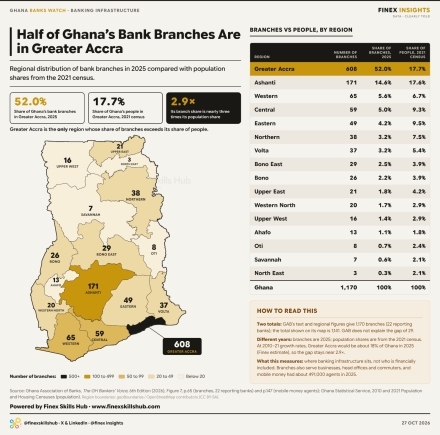
The country's bank branches are overwhelmingly concentrated in the Greater Accra Region, which hosts 608 outlets as of 2025, compared with just three in the North East Region, highlighting a deep regional divide in access to physical banking services, according to data from the Ghana Association of Banks.
The Greater Accra Metropolitan Area alone accounted for 52 per cent of the 1,170 branches covered by the association’s regional data population in the 2021 Population and Housing Census.
North East, by contrast, accounted for about 0.3 per cent of the branch availability.
The Founder and Lead Trainer of Finex Skills Hub, Bernard Obeng Boateng, said the disparity raised questions about the geographical distribution of banking services in a country where access to financial institutions could matter for households and businesses seeking services through conventional bank outlets.
The figures do not establish how many people lack access to banking, but they show that physical branches are concentrated far more heavily in some regions than others.
The imbalance extends beyond the capital. Ashanti Region had 171 branches, representing 14.6 per cent of the national total.
Together, Greater Accra Metropolitan Area and Greater Kumasi Metropolitan Area in the Ashanti Region accounted for 779 branches, or 66.6 per cent of the data, although those two most urbanised parts of the country represent about 35.3 per cent of Ghana’s population in 2021.
The remaining 14 regions shared 391 branches, equivalent to 33.4 per cent of the total, despite accounting for nearly two-thirds of the country’s population.
The distribution highlights a central challenge in assessing geographical access to banking: the locations with the largest branch networks are not necessarily those with the greatest share of the population.
Regional disparities
North East had the fewest branches— three— followed by Savannah with seven and Oti with eight. Ahafo recorded 13 branches and Upper West 16. The five regions together had 47 branches, fewer than the 49 recorded in Eastern Region alone.
The figures also show that disparities are not limited to northern Ghana. Eastern Region accounted for 9.5 per cent of the national population in the 2021 census but had 4.2 per cent of bank branches. Central Region represents 9.3 per cent of the population and accounted for five per cent of branches.
These comparisons suggest that some regions have a substantially smaller share of physical banking outlets relative to their population. However, population shares and branches alone cannot establish the severity of access constraints.
The number of people served by each branch, the distance customers travel to reach a bank, and the distribution of branches between urban centres and rural communities would provide a clearer picture of geographical inequality.
A region with relatively few branches may have most of its population clustered around accessible towns, while a region with more branches may still have communities located far from banking facilities. The supplied data do not show how these differences play out within individual regions.
Concentration in major centres
The Greater Accra Metropolitan Area and the Greater Kumasi Metropolitan Area’s combined share of two-thirds of the country’s reported branches points to the concentration of physical banking infrastructure in Ghana’s principal commercial regions.
Banks’ decisions about where to operate can reflect customer demand, business activity, deposits, lending opportunities and the costs of maintaining branches.
The regional figures do not provide enough information to determine how much each factor contributes to the observed distribution.
Nor do they establish that the concentration is commercially inefficient. They do, however, highlight the difference between locating banking infrastructure where commercial activity is greatest and ensuring that customers across the country can access appropriate services.
For people and businesses outside the largest commercial centres, the practical significance of a limited branch network depends on the availability of alternatives and the types of transactions those alternatives support.
Mobile money and the whole story
Ghana’s mobile money network provides another channel for financial services. The Ghana Association of Banks’ GH Bankers Voice, sixth edition, put the number of mobile money agents at approximately 491,000 in 2025.
That network may help extend access to routine financial transactions beyond communities served by conventional bank branches. But the national agent count does not reveal how those agents are distributed across regions or whether their services adequately compensate for differences in branch availability.
Mobile money agents and bank branches also do not necessarily provide identical services. The supplied data do not establish whether residents in regions with fewer branches have comparable access to credit, specialised banking services or other facilities available through formal banks.
As a result, the number of agents cannot, by itself, demonstrate that geographical inequalities in banking access have been resolved.
Measuring the gap
The regional figures offer a measure of where Ghana’s conventional bank branches are located, rather than a complete assessment of financial inclusion.
Comparisons of branches per 100,000 adults would help account for population differences. Data on travel distances to banking facilities, rural and urban access, regional mobile money coverage and the availability of credit would help establish whether residents can obtain the services they need without facing substantial geographical barriers.
Such measures would also help distinguish between a region with few branches but relatively accessible service points and one where customers must travel long distances to reach a bank.
The available data do not provide those measures, leaving the extent of the practical consequences uncertain.
Geographical inequality, closer examination
The 2025 bank-branch distribution shows a pronounced concentration of conventional banking infrastructure in Greater Accra and Ashanti, while North East, Savannah, Oti, Ahafo and Upper West have far fewer branches.
The figures do not prove that residents in these regions are financially excluded, nor do they establish that branch numbers should be proportional to population. They do show that the physical banking network is distributed unevenly across the country.
The next question is whether residents and businesses in regions with fewer branches can access comparable financial services through other channels, and at what practical cost in distance, time and availability.
Until those measures are available, the regional branch figures provide evidence of geographical inequality in banking infrastructure, but not a complete measure of inequality in access to financial services.