


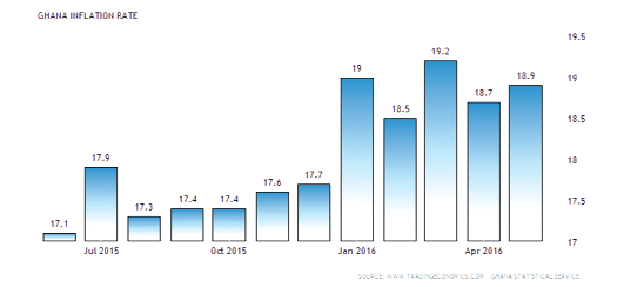
The country’s expected return to price stability suffered another setback after last week’s publication of the May consumer price index showed a 20 basis points (bps) increase to 18.9 per cent in May-2016. Inflation dropped from 19.2 per cent in March to 18.7 per cent for April.
As was widely expected, the five per cent increase in petroleum prices during the May price monitoring window, combined with higher food prices to sustain the upward pressure on inflation.
The country’s consumer price inflation has witnessed substantial swings since December 2015, reflecting a relatively steeper slope during the first five months of 2016.
But senior economist at Databank, Mr Courage Kingsley Martey, said the volatility in inflation reflected elevated uncertainty introduced by the concurrent hike in utility tariffs, energy sector levies (or petroleum prices) and transport fares in the first quarter of this year.
He said the increase in May-2016 inflation figures undermined expectations of a disinflation process from the second quarter of the year, posing a risk to the Bank of Ghana’s inflation target of eight per cent plus or minus 200bps by mid-2017 and the government’s 2016 target of 10.1 per cent.
“The sustained uncertainty in the outlook for inflation, given the excessive government borrowing would prevent an immediate decline in short term yields as the central bank maintains the tight monetary regime”, Mr Martey said in interview with the Graphic Business.
Inflation was over 19 per cent in March despite the Bank of Ghana setting interest rates at 26 per cent. National debt is now slightly over 70 per cent of GDP; that's the same level at which a decade ago, the previous government secured a deal under the World Bank's Heavily Indebted Poor Countries debt relief scheme.
Exchange rate stability
For now, the cedi exchange rate has stabilised, having lost about 50 per cent of its value against the dollar between 2012 and the end of 2015.
For now, the figures do not look better. The budget deficit, which was pegged at about seven per cent last year, is creeping downwards.
Back in 2012, the economy was still growing at around eight per cent and budget forecasts from the Ministry of Finance in November indicate that the country would reach 5.4 per cent growth this year were over-optimistic.
IMF growth
The IMF says growth will be closer to 4.5 per cent although this is still above average growth in Africa of some three per cent this year, according to the IMF, it falls far below what Ghana needs to create jobs and modernise the economy.
But the government says, the weak economy was caused not by bad policy, mismanagement and rent-seeking but simply by commodity price crashes.
The 2015 budget was premised on a price of US$99 for each barrel of oil that the country exported, but this year, the government plans to cut that to US$35-40 a barrel and a fall in the gold price from about US$1,800 an ounce in 2012 to about US$1,000/oz. at the start of this year.
Food Inflation
For now, the government says the hard times are a blip before the next boom and its opponents accuse it of wrecking the economy as prices of food items show a rise.
Food inflation sustained the upward drift with a 10bps climb to 8.5 per cent in May-2016, propelled by inflation for vegetables (11.6 per cent: +40bps), oil & fats (11.2 per cent: +60bps), fruits (10.3 per cent: +30bps) and cocoa, tea & coffee (8.9 per cent: +90bps).
Non-food Inflation
Non-food inflation (25.0per cent) edged up by 20bps, as a 10bps dip in utility inflation (35.7 per cent) was offset by transport inflation (40.9 per cent: +50bps) and education (32.3 per cent: +140bps).
Although a three per cent increase in petroleum prices and a 1.5 per cent cedi depreciation during the June data window poses a marginal upside risk, It is expected that the downside risks from the base effect, utility and other sub-groups to trim June 2016 inflation by 10bps to 18.8 per cent.