


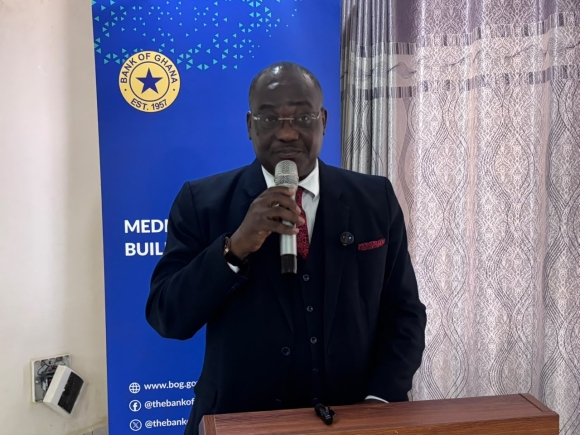
The Director of Communications at the Bank of Ghana (BoG), Bernard Otabil, has underscored the critical role of ethical financial journalism in combating disinformation and misinformation, describing the phenomenon as a severe global threat.
At the opening of the three-day training workshop for the Bank of Ghana Press Corps at Koforidua in the Eastern Region today, Mr Otabil explained that misleading reports on inflation, exchange rates and policy rates could create panic, fuel speculation and negatively affect households and businesses.
Welcoming participants, Mr Otabil said the workshop forms part of the bank's continued commitment to build a well-informed media.
"Monetary policy is most effective when it is understood, trusted and accurately communicated," he said.
He specially welcomed the National Organising Secretary of the Ghana Journalists Association (GJA), Suleiman Mustapha, and Member of the Press Corps, and all members who had travelled for the programme.
Mandate
Outlining the programme, Mr Otabil said day one would cover the ethics of media reporting, the mandate and regulatory role of the bank, and understanding the central bank balance sheet.
“Day two will focus on the domestic gold purchase programme, trends in the foreign exchange market, inflation dynamics, and how to interpret MPC statements and individual member submissions which was a major transparency reform; and day three will examine case studies on ethical dilemmas in financial journalism,” he said.
Mr Otabil said members of the Press Corps play a critical role, as the public may not read MPC reports but relies on headlines and reports to make economic decisions.
"Accuracy therefore is not just a professional virtue, it is an economic asset," he stressed.
On why the workshop is starting with ethics, Mr Otabil, who is also a former head of the bank’s Ethics and Internal Investigations Office said ethics of financial journalism matters because in finance, words move markets.
“A misleading headline on inflation, exchange rates, or the policy rate can create panic, fuel speculation, and hurt the very households and businesses we are trying to protect. Ethical reporting - grounded in verification, balance, context, and clarity - is our first defence against disinformation and misinformation,” he said.
Misinformation
He explained that misinformation and disinformation were no longer peripheral concerns, citing the World Economic Forum's Global Risks Report which now ranks them among the most severe global threats.
"From deepfakes to AI-generated market rumours, from social media amplification to coordinated disinformation campaigns targeting currencies, no central bank and no country is immune.
“This is a global phenomenon, driven by technology and the speed of digital platforms, and it has undermined public trust everywhere," he said.
Mr Otabil added that credibility has become journalism's most valuable asset.
"When you uphold ethical standards, you do more than file a story - you anchor expectations, protect savings, safeguard economic stability, and help Ghanaians make informed choices," he said.
Commitment
He reiterated the bank's commitment to deepening its partnership with the media through expanded training, the Regional Press Corps, Editors' Forum, dedicated communication platforms, and the Governor's Economic and Financial Story of the Year Award.
He commended participants for their partnership over the past year and encouraged them to participate fully, ask questions and challenge the bank.