


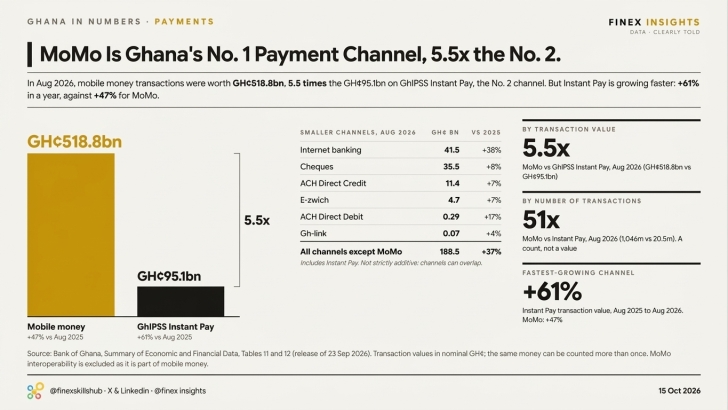
Mobile money users in Ghana made 1,046 million mobile money transactions worth GH¢518.8 billion in August, more than five times the GH¢95.1 billion recorded by GhIPSS Instant Pay, the country’s second-largest payment channel, according to the Bank of Ghana’s latest financial data.
By volume, mobile money handled 51 times as many transactions as Instant Pay, maintaining its position as Ghana’s dominant digital payment channel even as bank transfers recorded faster growth over the year.
Internet banking followed with transactions worth GH¢41.5 billion, while cheques accounted for GH¢35.5 billion. Other channels, including Automated Clearing House (ACH) transfers, E-zwich and Gh-link, recorded much smaller values.
However, mobile money was not the fastest-growing channel. The value of transactions through Instant Pay rose 61 per cent between August 2025 and August 2026, compared with 47 per cent for mobile money. Internet banking grew 38 per cent, while cheque transactions increased eight per cent.
Consumer prices rose about five per cent over the same period, suggesting inflation alone did not explain the growth in transaction values.
Different payment needs
The average mobile money transaction in August was about GH¢496, compared with approximately GH¢4,640 for Instant Pay transfers. The average cheque transaction was about GH¢90,000.
The differences point to the distinct uses of the channels. Mobile money is widely used for everyday transactions, including market purchases, transport fares, remittances and payments to small businesses. Instant Pay facilitates transfers between bank accounts and is used for larger payments.
The two channels serve different payment needs, although their functions can overlap. The faster growth of Instant Pay suggests bank transfers are becoming increasingly important in Ghana’s digital payment system.
Registered accounts
Ghana had 85.8 million registered mobile money accounts in August, but only 26.4 million were active, meaning they had recorded transactions within the previous 90 days.
The number of registered accounts exceeded the country’s population, suggesting many users held more than one wallet. The gap between registered and active accounts also showed that registrations alone could not provide a complete picture of actual usage.
The transaction figures require careful interpretation. The value of transactions does not represent the amount of money available in the economy or the revenue earned by payment providers, as the same money can move through several transactions and be counted each time.
Payment channels can also overlap. A transfer from a bank account to a mobile wallet, for instance, may appear in more than one data series, so adding values across channels may produce only an indicative picture of total payment activity. The figures are nominal and may be revised by the Bank of Ghana.
Competition and security
The growing use of digital payments presents opportunities for banks and mobile money operators, but also raises questions about reliability, pricing and security.
For banks, the faster growth of Instant Pay suggests customers are willing to use bank transfer systems when they are convenient and affordable. For mobile money operators, the challenge is to retain everyday users while larger-value transactions increasingly move through bank channels.
The concentration of everyday payments on mobile money also creates risks, as a major service outage or a change in transaction charges could affect a large number of users and businesses. Maintaining effective interoperability between mobile wallets and bank accounts will be important to ensuring customers can move money across platforms conveniently.
Fraud prevention
Against this backdrop, Shaibu Haruna, chief executive of MobileMoney Fintech Limited (MMFL), the operator of MTN MoMo, called for greater collaboration among industry players and customers to tackle digital financial fraud.
He said the company was investing in technology and security solutions to protect its platform, but customers also had a responsibility to safeguard their accounts.
“Our customers also need to go on the journey with us because they are the first line and last line of defence,” he said.
Mr Haruna was speaking at the Fintech Media Development Series in Accra, organised by MMFL on the theme “Understanding Fintech, Building Trust, Telling the Real Story”.
He said the mobile money ecosystem processed GH¢3.37 trillion in transactions in August 2026, compared with more than GH¢4 trillion for the whole of 2025. He explained that the figure represented transaction flows across the ecosystem, including agent-to-agent transfers, merchant payments and consumer transfers, rather than the company’s revenue.
MMFL processed more than 26 million transactions daily and was scaling up artificial intelligence tools to help detect and combat fraud, much of which was driven by social engineering, he said.