


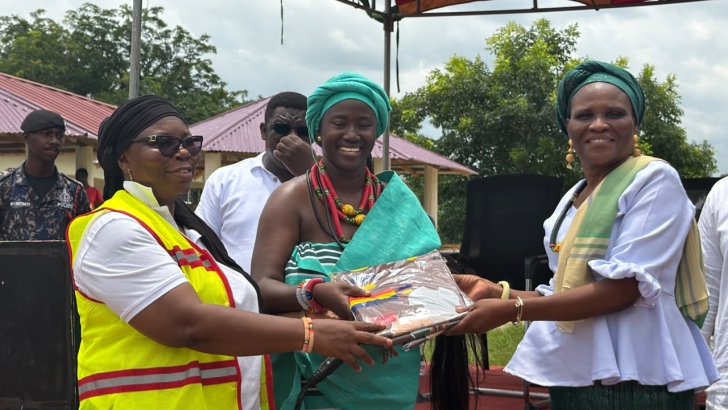
The Centre for Indigenous Knowledge and Organizational Development (CIKOD), in partnership with the Lawra Municipality, Global Shea Alliance and Green Gold Savannah, has launched a Shea Enrichment Planting Initiative to restore degraded shea landscapes and strengthen livelihoods in the Upper West Region.
The initiative, launched on Friday, August 21, 2026, at the Farmer Managed Natural Regeneration Conservation Site at Pavuu, seeks to complement natural regeneration efforts by enriching existing shea parklands with trees of ecological, cultural and economic value.
The launch brought together traditional authorities, government officials, development partners, farmers, shea collectors, women and youth groups, community leaders and other stakeholders committed to sustainable landscape restoration.
Speaking at the launch, the Executive Director of CIKOD said the initiative went beyond the planting of seedlings, stressing that it was about building on the restoration gains already achieved by the people of Pavuu.
"Today is not simply about planting trees. Today is about celebrating what communities have already achieved, and committing ourselves to doing more," he said.
He explained that the Pavuu site, which was severely degraded more than a decade ago, had experienced significant regeneration through community commitment, indigenous knowledge and the Farmer Managed Natural Regeneration approach. He said the transformation demonstrates what communities can achieve when they are recognised as custodians of natural resources and their indigenous knowledge is integrated into environmental restoration.
He said FMNR combines ecological restoration with local governance, requiring communities to protect trees, manage bushfires, control livestock and develop mechanisms for sharing the benefits derived from natural resources.
The CIKOD Executive Director cited findings from an Economics of Land Degradation study which indicated that FMNR, when combined with appropriate farming practices, could increase cropland productivity by at least 83 percent within five years under the conditions studied.
He said the evidence should encourage policymakers, development partners and investors to view landscape restoration as an economic investment rather than a cost.
"The cost of land degradation is already being paid, in declining soil fertility, reduced agricultural productivity, loss of biodiversity, vulnerability to drought and climate shocks, and declining livelihood opportunities," he said.
He acknowledged Groundswell International for supporting CIKOD and communities in advancing FMNR through investments in people, indigenous knowledge and community institutions.
The Executive Director explained that enrichment planting would complement natural regeneration by introducing or strengthening tree species with ecological, cultural and economic importance. He said shea had been deliberately selected because of its central role in food security, household income, culture, biodiversity and livelihoods across Northern Ghana.
"Shea is much more than a tree," he stressed, calling for greater investment in the regeneration and protection of shea parklands instead of relying solely on existing mature trees.
The Upper West Regional Minister, Charles Lwanga Puozuing Esq., whose speech was delivered by his representative, Pognaa Fati Koray, said the initiative represented an investment in the future of the region.
"Today is not simply about putting seedlings into the soil. Today is about putting hope into the ground," he said.
According to him, the shea tree is an economic asset, an environmental resource, a source of household income and an important component of the agricultural and cultural identity of Northern Ghana. He noted that generations of families, particularly women, had depended on shea collection and processing for food, income and employment.
However, he said the resource was increasingly threatened by bushfires, indiscriminate tree felling, land degradation, agricultural expansion and changing climatic conditions.
"When a mature shea tree is destroyed, we do not simply lose a tree. We lose years of accumulated ecological and economic value," he said.
He therefore urged stakeholders to move beyond tree planting campaigns to ensuring that seedlings survive, mature and deliver tangible benefits to communities. He said the initiative was consistent with Government's broader commitment to sustainable agriculture, environmental restoration, climate resilience, job creation and value addition.
The Minister's representative also referenced the Green Ghana initiative and Ghana's national forestry policy, saying restoration efforts must move beyond a culture of simply planting trees.
"The real measure of success is not the number of seedlings distributed; it is the number that survive, mature and generate benefits for communities," he said.
The Regional Minister further urged stakeholders to use the shea sector as a platform for industrialisation and economic transformation in the Upper West Region. He said the establishment of the Tree Crops Development Authority provided an important framework for improving production and productivity, strengthening value chains, supporting research and building the capacity of farmers and other actors within the tree-crop sector.
"We must not remain merely producers of raw agricultural commodities. We must increasingly become a region of value addition, processing, enterprise development and competitive agribusiness," he said.
He called for increased investment in modern processing, quality standards, packaging, cosmetics, food products, industrial applications and export markets. He also stressed the need to ensure that women and communities who sustain the shea value chain receive a fairer and increasing share of the value created.
The Regional Minister's representative emphasised the central role of women in the shea economy, noting that a healthy shea landscape directly translates into household income, resilience and economic security for many women.
He also cautioned that planting was only the beginning of the restoration process, insisting that the survival of planted trees must become the real measure of success.
"Planting is only the beginning; protection is the real test," he said.
He called on traditional authorities to lead community-level protection of shea landscapes by strengthening local rules against indiscriminate tree felling, intensifying bushfire prevention and promoting responsible farming practices.
The Ambassador of the Upper West SheaPark Resource Hub Project also underscored the importance of the initiative, describing it as part of a broader national agenda for sustainable landscape development. She said the development of Ghana could only be meaningfully assessed when all landscapes across the country demonstrated improvements in the quality of livelihoods and environmental sustainability.
The CIKOD Executive Director said the ambition of the initiative extended beyond the Pavuu conservation site to degraded landscapes across the Upper West Region and eventually other parts of Ghana. He called for stronger collaboration among communities, traditional authorities, local and national institutions, researchers, development partners and the private sector.
"We need to move from isolated restoration projects towards landscape-level environmental governance," he said.
He further called for policies that recognise communities as custodians of natural resources, long-term financing for restoration and mechanisms that enable communities to derive economic benefits from the landscapes they protect.
The initiative is supported by CIKOD, Green Gold Savannah, the Global Shea Alliance and Groundswell International.