



The Chartered Institute of Bankers, Ghana (CIB Ghana) has called for stronger professional and ethical standards across the banking industry as artificial intelligence (AI), virtual assets and tokenisation reshape financial services.
The call was made at the conclusion of the Ghana Banking Conference 2026, the Institute’s 30th National Banking and Ethics Conference, held from November 9 to 10 at the Aqua Safari Resort in Ada. Themed ‘Banking on the Future: Trust, Technology and Transformation’, the event brought together bank chief executives, board chairs, regulators, policymakers and industry professionals. It marked the first time the conference was held outside Accra in its 30-year history.
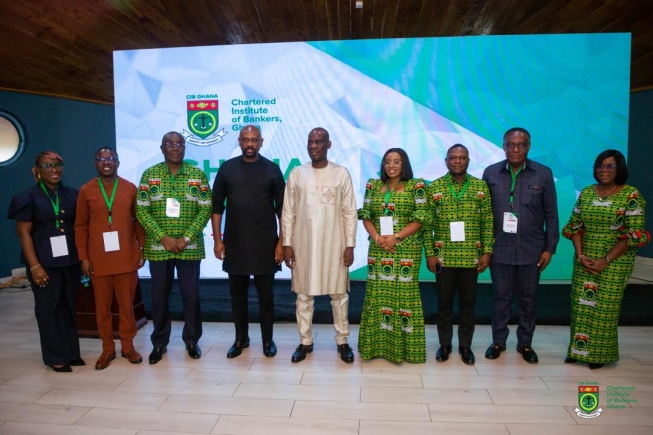
Review of banking legislation
The Minister for Education, Hon Haruna Iddrisu, who formally opened the conference, invited the Institute to submit proposals for reviewing the legal framework governing the banking profession, pledging to convey the recommendations to the Minister for Finance.
“How does our banking legislation strengthen trust? How does our banking legislation make ethical use of technology? And how does our banking technology progressively respond to the needs of the people? Get your team to look at it properly so that as I leave here, I will have a policy blueprint informed by your professional input,” Hon Iddrisu said.
He also advocated the integration of financial literacy into foundational education, describing loan default as a breach of trust. “My first recommendation is for you to advise the government, and we're happy to do so, to integrate financial literacy into basic foundational learning. Default, in my view, means betrayal of trust,” he said.
Prioritising professionalism
CIB Ghana President, Dr Ellen Ohene-Afoakwa, FCIB, reaffirmed the Institute’s commitment to raising professional standards and deepening its influence on banking policy.
“We will significantly raise the bar on professionalism, ethics, research and policy influence within the banking industry,” she said.
She identified fraud, cyber threats and unethical conduct as major challenges requiring collective industry action, while highlighting plans to upgrade the Institute’s digital and physical infrastructure, including its proposed Bankers' House.
“Our collective fight against fraud, cyber threats and unethical behaviour is key to building public trust in the banking system and the economy,” she said. “In the end, banking is not just about systems. It is about the values that guide our decisions, the trust we earn from the public every single day.”
Governor cautions on ethics
The Governor of the Bank of Ghana, Dr Johnson Pandit Asiama, commended the Institute for sustaining the conference over three decades. His address was delivered by the Director of Communications, Mr Bernard Otabil. He stressed that technological innovation must complement, rather than undermine, the principles underpinning a stable banking system.
“Innovation should advance the interests of customers and the economy, but it must not weaken the principles of integrity, accountability, and financial stability,” the Governor said. “The most effective safeguard is an industry culture in which ethical conduct is embedded in decision-making and consistently upheld, not merely observed when regulators are present.”
The Virtual Assets frontier
The Chief Executive Officer of Npontu Technologies, Dr Stephane Nwolley, delivered the keynote address on the future of the tokenised economy, challenging banks to move early in developing their virtual assets capabilities. He warned that a failure to engage with the emerging asset class could leave traditional financial institutions behind.
“If we do not take time, that which happened to mobile money would happen to us. Is doing nothing an option?” Dr Nwolley said. He proposed a 90-day action plan for bank boards and executives, beginning with the appointment of an executive responsible for virtual assets, followed by an assessment of regulatory requirements and a pilot product.
Cyber risks and AI-driven fraud
The conference featured masterclasses covering virtual assets, cybersecurity and AI-driven fraud. Discussions focused on board-level accountability for cybersecurity, intelligence-sharing among financial institutions, and the need for human oversight in AI fraud detection.
Ms Audrey Mnisi Mireku of the Ghana Association of Banks (GAB) identified inadequate intelligence-sharing as a major weakness in the industry's response to cybercrime. “The reason today cyber criminals are able to defraud one person all the way to the bank is because we do not share intelligence,” she said.
Board Chairman of Fidelity Bank Ghana, Mr James Reynolds (Jim) Baiden, stressed the importance of competence in board appointments. “Gone are the days where we appointed friends and acquaintances to the board. If you do that today, you do that at your own risk,” he said.
Certification and future hosting
The Chief Executive Officer of the GAB, Mr John Awuah, announced that the two industry bodies were developing a virtual assets certification programme for bankers to build on the Ghana Banking Code of Ethics.
“Virtual assets have come to stay, and we have to participate and know everything about it, because it is the next frontier of banking,” Mr Awuah said. “Let us live by the ethical standards that we have all set for ourselves.”
The conference also provided an opportunity for the Institute to outline preparations for hosting the World Conference of Banking Institutes (WCBI) in Accra in 2028. Mr Robert Dzato, CEO of CIB Ghana, said the event would be formally launched in the first quarter of 2027 and is expected to attract approximately 1,500 delegates.
“In June this year, we took over 50 bankers from Ghana to the world. And we are bringing the world to Ghana,” he said. “The business of banking is trust. That is the currency in banking, really. And that trust comes from the character, competence and conduct of bankers.”