


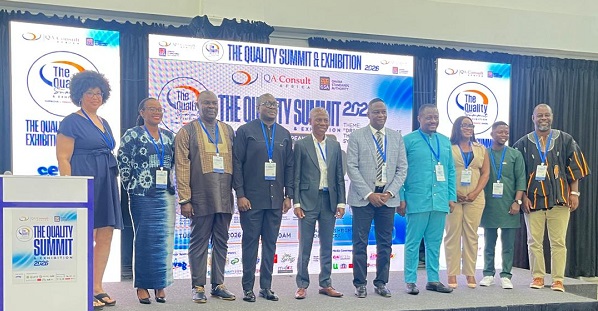
Businesses risk losing consumer confidence and undermining their long-term sustainability if they fail to prioritise quality assurance in the production and delivery of goods and services, former Managing Director of Unilever Ghana and Ethiopia, George Owusu-Ansah, has warned.
He explained that business leaders had a serious responsibility to guarantee the safety and quality of products consumed or used by millions of people who trusted manufacturers to meet promised standards.
Speaking at the Quality Summit and Exhibition in Accra on November 10, Mr Owusu-Ansah stressed that maintaining quality was essential to building consumer trust and ensuring sustained business performance.
“Businesses must, therefore, continuously innovate while protecting product and service quality to remain relevant, competitive and trusted by consumers,” he said.
Summit
The maiden edition of the Quality Summit organised by QA Consult Africa, brought together business executives, chief executive officers, quality professionals, regulators, development partners, SMEs and young entrepreneurs to discuss how quality systems could drive organisational performance.
On the theme, “Driving performance through quality systems,” the summit sought to promote a national culture of quality across businesses, professions and public institutions.
It provided a platform for stakeholders to explore ways of improving the quality of goods and services, equipment, education and public infrastructure to enhance productivity and build public confidence.
Innovation and quality
The former MD said quality assurance should not be treated as an isolated production requirement but embedded in every aspect of business operation, including product development, cost management, marketing, advertising and customer service.
He explained that continuous innovation enabled businesses to respond to changing consumer needs and aspirations, while consistent quality ensured that customers received the standards promised by manufacturers.
“Relevance for me means continuous innovation, and then when you have innovated, you make sure that you deliver whatever you have innovated to the standards that you have promised and the consumer has come to expect,” he said.
Mr Owusu-Ansah said companies that failed to adapt and maintain quality standards risked losing their place in the market as consumers increasingly demanded reliable products and services.
He urged business leaders to make innovation and quality integral to their corporate strategies, stressing that the two were essential to building lasting consumer relationships and driving sustainable growth.
Quality systems
The Deputy Director-General in charge of General Services at the Ghana Standards Authority (GSA), Samuel Abdulai Jabanyite, urged businesses to adopt internationally recognised quality management systems to improve operational efficiency, strengthen consumer confidence and enhance their competitiveness in local and international markets.
He said effective quality systems enabled organisations to minimise waste, optimise resources, manage operational risks and improve productivity, thereby contributing to profitability and long-term business resilience.
Mr Jabanyite said the opportunities presented by the African Continental Free Trade Area (AfCFTA) could only be fully harnessed if Ghanaian businesses ensured that their products and services consistently met recognised standards across markets.
“Quality therefore serves as a passport to competitiveness and market access,” he said.
Poor quality
The Chief Executive Officer of QA Consult Africa, Johnson Opoku-Boateng, has called for stronger accountability among businesses and public institutions to address persistent quality failures in products, services and infrastructure.
He said poor quality came at a significant cost to businesses and society through product defects, infrastructure failures, financial losses, injuries and the erosion of public confidence.
Mr Opoku-Boateng cited examples such as defective manufactured products, unresolved customer complaints, unsafe vehicles and buildings, and roads that deteriorated before the end of their expected service life.
“Behind each failure is a cost. Someone pays for repairs, loses productive time, suffers an injury, or loses confidence in an institution. Sometimes a family loses a loved one,” he said.