


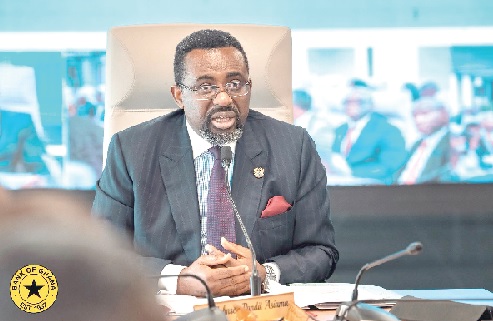
The policy decision-making body of the Bank of Ghana (BoG), the Monetary Policy Committee (MPC), has maintained its policy rate at 14 per cent, citing the need to keep inflation on course towards the medium-term target while safeguarding the country's economic recovery.
It marks the third consecutive time the committee has kept the policy rate unchanged at 14 per cent following similar decisions in March and May this year, underscoring its cautious approach to monetary policy.
In reaching the decision, the MPC weighed heightened geopolitical tensions, rising crude oil prices and persistent global inflationary risks against Ghana's resilient macroeconomic fundamentals, concluding that the current policy stance remained appropriate to preserve price stability.
Announcing the outcome of the committee's 131st meeting at the Bank Square in Accra yesterday, the Governor of the BoG, Dr Johnson Pandit Asiama, said robust first-quarter economic growth, improving private sector credit, stronger external sector performance and inflation remaining below the lower bound of the target band supported the decision to leave the benchmark rate unchanged.
"The committee, by a unanimous decision, maintained the monetary policy rate at 14.0 per cent," he said.
Global risks
Dr Asiama said although global economic activity had remained resilient, renewed geopolitical tensions in the Middle East continued to pose significant risks to the global outlook through higher energy prices and supply chain disruptions.
He explained that crude oil prices had rebounded above $85 per barrel following the renewed conflict, slowing the pace of disinflation across many economies, and prompting several central banks to pause monetary policy easing.
“The persistence of these external shocks could result in tighter global financing conditions with adverse effects transmitted through the trade and financial channels of emerging markets and developing economies such as Ghana,” he said.
Resilient domestic economy
On the domestic front, Dr Asiama stated that Ghana's economy remained resilient, supported by strong growth in output, improving business confidence and a sharp expansion in private sector credit.
He said real Gross Domestic Product (GDP) grew by 6.4 per cent in the first quarter of 2026, driven by the services and industry sectors, while the Bank's Composite Index of Economic Activity (CIEA) recorded annual growth of 13.4 per cent in May 2026, compared with 4.4 per cent in the same period last year.
He stressed that consumer and business confidence had improved on the back of subdued inflation, declining lending rates and optimism about economic prospects.
"Positive business and consumer sentiments, an easing credit environment, and a significant increase in private sector credit growth are expected to boost economic activity going forward," he stated.
He added that average lending rates had declined to 15.6 per cent from 27 per cent a year earlier, helping private sector credit to expand by 41.2 per cent in June 2026.
Banking performance
Dr Asiama said Ghana's external sector continued to post strong results despite higher energy import costs arising from the Middle East conflict.
He explained that the country's trade surplus improved to $8.8 billion in the first half of 2026 from $5.8 billion during the corresponding period in 2025, driven by strong gold and cocoa export earnings, while the current account surplus widened to $5.1 billion.
"Notwithstanding the decline, the current level of reserves provides adequate buffers for the economy to withstand external shocks," he added.
He said gross international reserves stood at $12.9 billion, equivalent to five months of import cover at the end of June, while the banking sector remained sound, with the capital adequacy ratio improving to 20.4 per cent and the non-performing loans ratio declining to 16.1 per cent from 23.1 per cent a year earlier.
Inflation outlook
On inflation, the Governor said headline inflation rose to 5.3 per cent in June from 3.7 per cent in May, largely due to base effects and temporary increases in transport fares following higher crude oil prices.
He explained that although inflation expectations had edged up, they remained broadly anchored within the central bank's medium-term target band, while the latest forecast suggested inflation would gradually move back into the target range.
"The current policy stance remains appropriate to guide inflation into the medium-term target band while allowing time to assess the evolving geopolitical developments and their potential impact on the domestic economy," the Governor added.