


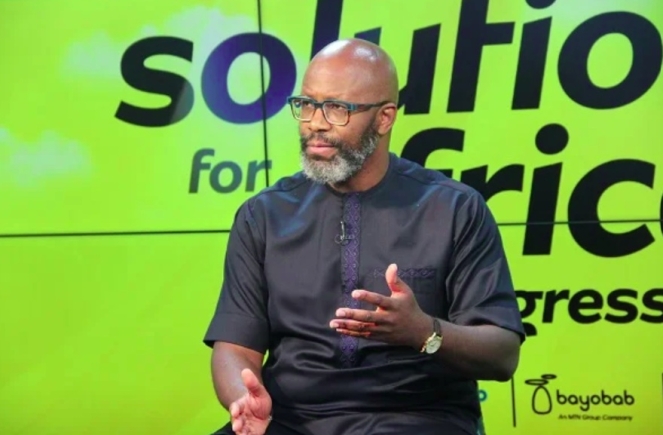
Africa’s largest mobile operator, MTN, is seeking a regional banking license in Nigeria and financial services licenses in Ghana and Rwanda, as it pushes deeper into lending, savings, and remittances, its Chief Executive Officer, Ralph Mupita, has disclosed.
Speaking at Semafor’s Next Three Billion summit in Johannesburg, Mr Mupita stated that the company expects to secure the licenses “in the next year or two.”
The move takes MTN further beyond its mobile money roots and into territory traditionally occupied by the continent’s banks, as it looks for new revenue streams from a fintech platform with 70 million active users.
He noted that basic mobile services such as peer-to-peer transfers and cash-in, cash-out would increasingly become commonplace, pushing MTN toward higher-value financial services.
MTN processed transactions worth more than $500 billion through its fintech network in the nine months through the end of September, Mr Mupita revealed. He added that the company is primarily planning to expand the business organically and “we’re not looking at the conventional kind of M&A” for the business.
Mobile money has become a major business for Africa’s telecom operators since Kenya’s Safaricom launched M-Pesa in 2007, initially allowing customers to send and withdraw money without a bank account. Competitors have since built large financial services around the model, with Airtel Money, the financial services business controlled by Airtel Africa, valued at about $7 billion at its London listing last month.
The push into financial services comes as Mr Mupita is also arguing for consolidation in MTN’s traditional telecommunications business. He stated that South Africa’s mobile market needs to coalesce around two or, at most, three operators, comments that have gained significance since MTN this month revived talks to buy Telkom, the country’s former fixed-line monopoly.
“We believe that ultimately, for a better technology and telecommunications market in South Africa, consolidation is inevitable, as has happened in Europe,” he said, adding that in Europe, consolidation had supported greater investment without raising consumer prices.
A tie-up would bring together MTN’s South African mobile business with Telkom mobile users, fiber infrastructure and enterprise operations. Mr Mupita noted that South Africa’s regulatory thinking may also be shifting, stating that competition policy had traditionally placed greater emphasis on consumer choice than investment.
“I think that is changing,” he added.