


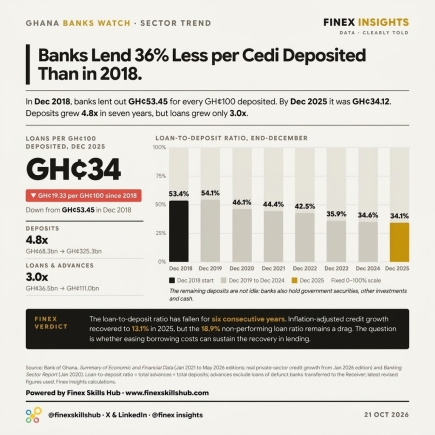
Deposits have almost quintupled in seven years. Lending has only tripled. With treasury bill yields collapsing, the question for banks is shifting from whether they can afford to lend more to whether they can afford not to.
For every GH¢100 Ghanaians held in banks at the end of 2018, the banking sector had GH¢53.45 out on loan. By December 2025, that figure had fallen to GH¢34.12. Measured this way, banks now lend 36 per cent less per cedi deposited than they did seven years ago.
This is not a story of shrinking credit. Bank of Ghana data show total advances rose from GH¢36.5 billion to GH¢111.0 billion over the period, roughly tripling. The issue is that deposits grew far faster, from GH¢68.3 billion to GH¢325.3 billion, almost five times. Lending has grown; it has simply not kept pace with the money flowing into banks.
The loan-to-deposit ratio has now fallen for six consecutive years, from 54.1 per cent in 2019 to 34.1 per cent in 2025. The latest data suggest the slide has not yet stopped: by April 2026 the ratio stood at 31.5 per cent.
Where did the money go?
A low ratio does not mean the rest of the money sits idle in vaults. Banks also hold government securities, other investments and liquid assets. Even in December 2018, investments made up 36.3 per cent of bank assets, slightly more than gross loans at 34.7 per cent. At the end of 2025, core liquid assets alone accounted for 30.9 per cent of total assets.
For years, that preference was rational. Treasury bills paid double-digit yields, while loan books were under strain: the non-performing loan ratio stood at 21.8 per cent at the end of 2024, meaning more than one in five cedis lent was not being repaid as agreed. The 2022 domestic debt exchange showed that government paper carries risk too, but for many banks it remained the easier bet.
The calculus is changing
Three shifts in the Bank of Ghana’s own figures suggest the era of easy returns from government paper is ending.
First, yields have collapsed. The 91-day Treasury bill rate fell from 15.47 per cent in April 2025 to 4.90 per cent in April 2026, while the policy rate was halved from 28 per cent to 14 per cent over the same twelve months.
Second, margins are being squeezed. The industry’s net interest margin fell from 14.0 per cent to 9.3 per cent between April 2025 and April 2026, and return on equity fell from 30.0 per cent to 22.4 per cent. Profits remain healthy, but the windfall is fading.
Third, borrowing is getting cheaper. The average lending rate fell from 27.40 per cent to 16.33 per cent over the same period, bringing more projects within reach of borrowers.
There are early signs of a response. Adjusted for inflation, private-sector credit grew 13.1 per cent in 2025, up from just 2.0 per cent in 2024, and accelerated to 24.5 per cent in the year to April 2026. Total advances grew 25.0 per cent in the year to April 2026, close to deposit growth of 26.2 per cent.
A note of caution: much of the real-terms recovery in 2025 reflects falling inflation rather than faster lending. Nominal private-sector credit growth actually slowed from 26.3 per cent to 19.2 per cent during 2025, before picking up to 28.7 per cent in April 2026.
The bad-loan anchor
The biggest brake remains asset quality. The non-performing loan ratio was 18.9 per cent in December 2025 and 18.0 per cent in April 2026, still far above the 10 per cent that the Bank of Ghana has directed banks to reach by the end of 2026. Banks still working through old problem loans are understandably cautious about writing new ones.
Why it matters
For businesses and small firms in particular, a falling ratio means a smaller share of the nation’s savings is reaching productive investment. For banks, falling yields on government securities mean growth must increasingly come from lending, which in turn demands better credit assessment, smarter use of transaction data and stronger loan recovery.
The number to watch in 2026 is simple. If loans grow faster than deposits for a full year, the six-year decline will end. With the 91-day bill now paying under five per cent, banks may find that lending is no longer the risky option, but the necessary one.
The writer is the Lead Trainer at Finex Skills Hub
- www.finexskillshub.com
email: