


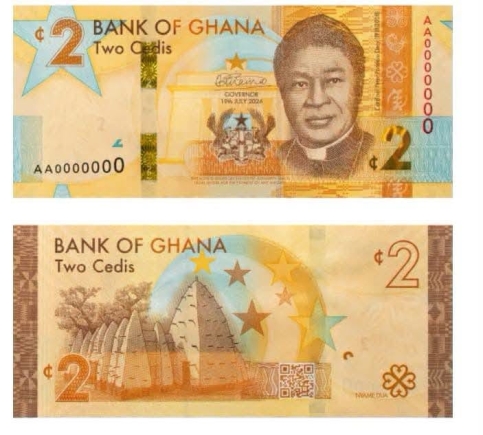
The Bank of Ghana (BoG) has unveiled the new GH¢2 banknote as part of the Cedi Heritage Series, with its thematic foundation revolving around Religion, reflecting Ghana's status as a secular state where Christianity, Islam, and African traditional religion are practised side by side.
The front of the note features the intaglio portrait of Cardinal Peter Poreku Dery (1918–2008), representing the Christian majority of Ghanaians. Cardinal Dery was a pioneering Roman Catholic prelate from northern Ghana whose extensive ecclesiastical career spanned key moments in Ghana's post-independence religious landscape.
He served as Bishop of Wa from 1960 to 1974, and subsequently as Archbishop of Tamale from 1977 to 1994, and was created cardinal by Pope Benedict XVI in 2006, becoming the first Ghanaian from the northern regions to be so elevated. His contributions extended beyond church administration, establishing the Wa Agricultural Training School, pioneering vernacular liturgy in northern Ghanaian languages, and advocating for interfaith dialogue.
His composition of the first Mass in Dagaare gave practical form to that commitment to worship in the vernacular. Cardinal Dery combined religious leadership with significant community development initiatives that transformed educational and healthcare infrastructure in northern Ghana.
The back of the note features the Larabanga Mosque, which represents the Islamic faith in Ghana. Often called the "Mecca of West Africa," the mosque is an architectural milestone traditionally dated to 1421.
Founded by an Islamic trader named Ayuba following a divine dream, this historic mosque serves as an active place of worship for the local Muslim community and a protected cultural heritage site. The Larabanga Mosque is a significant symbol of the cultural exchange facilitated by centuries of trans-Saharan trade and continues to draw spiritual pilgrims.
Connecting Cardinal Dery with the Larabanga Mosque on the banknote philosophically represents Ghana's religious heritage and interfaith tolerance. Although representing different faith traditions, they collectively reflect Ghana's longstanding tradition of religious tolerance, coexistence, and mutual respect. Together, they also reflect the breadth of Ghana's spiritual heritage, from the northern regions to the south, underscoring the country's rich religious diversity and shared tradition of peaceful coexistence.
Furthermore, the indigenous identity of Ghana has been fused with traditional religious foundations through the Adinkra symbol "Nyame Dua," a symbol of God's Presence and protection, found at the back of the banknote and among the background graphical elements at the front.
This visual connection celebrates the commitment to interfaith harmony and embodies Ghana's constitutional imperative for the state and citizens to avoid religious discrimination and safeguard religious freedom.