


As billions in climate finance flow into the continent, African nations face a critical policy juncture: will the renewable energy boom spark genuine industrial transformation or merely repackage historical dependencies in a greener shade?
“The axe forgets, but the tree remembers.” This traditional African proverb, recently invoked by policy experts analysing the continent's energy trajectory, starkly reminds us of the historical inequities that have long characterised foreign investment in Africa.
Today, as the world races toward decarbonisation, African policymakers face a monumental challenge: how to manage the global energy transition without undermining their energy security and economic development goals.
The "energy trilemma"
For many African nations, the push for renewable energy collides with deeply entrenched structural challenges within their existing power sectors. Ghana serves as a potent case study of this dilemma.
In the contemporary global landscape, energy transition and energy security are the two primary pillars shaping international relations, economic policy and environmental sustainability. While often viewed as complementary goals, they frequently exist in tension.
Energy transition refers to the global energy sector's structural shift from fossil-based energy production and consumption (oil, natural gas, and coal) to renewable and low-carbon sources (wind, solar, lithium-ion batteries and hydrogen).
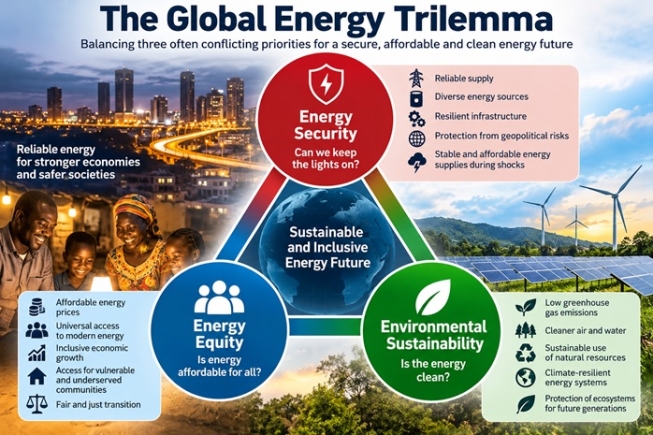
Global policymakers must manage what is known as the Energy Trilemma,balancing three often conflicting priorities:
• Energy Security: Can we keep the lights on?
• Energy Equity: Is energy affordable for all?
• Environmental Sustainability: Is the energy clean?
The new geopolitics of energy
The transition is fundamentally reshaping the global power map. We are moving from a world of "Fuel Geopolitics" to "Mineral Geopolitics."
While the 20th century was defined by who controlled oil (OPEC), the 21st century is being defined by who controls Critical Minerals (Lithium, Cobalt, Copper, Nickel and Rare Earth Elements) needed for batteries and turbines.
Currently, China dominates the refining and processing of these minerals. Global energy security now depends on diversifying these supply chains so that the world does not trade dependence on Middle Eastern oil for dependence on Chinese processing.
In the global context, natural gas is often viewed as a "bridge fuel."
For many developing nations (especially in Africa and Asia), natural gas is seen as essential for energy security—providing reliable base-load power while they build up their renewable capacity.
In the global context, the energy transition is a necessity for planetary survival, but it cannot succeed without energy security.
If the transition is too slow, climate change worsens; if it is too fast and uncoordinated, it leads to price spikes and blackouts that undermine public support for green policies.
To avoid the trap of stranded assets and mounting debt, African policymakers are increasingly drawing a hard line. This distinction maps directly onto the debates that have accompanied international energy partnerships for the past two decades, from the early Kyoto protocols to the Just Energy Transition Partnerships (JETPs) of the early 2020s.
Historically, large-scale capital has been committed to African energy projects where renewable capacity is installed and emissions are reduced.
However, the manufacturing base, engineering skills, component supply chains and long-term maintenance ecosystems have remained predominantly external. In this model, Africa serves merely as a site for green energy deployment rather than a center of green industrial production.
To leverage these new frameworks for genuine economic development without compromising energy security, African nations must exercise rigorous policy discipline at the national level. These could be three non-negotiable imperatives:
First, the instinct in international partnerships is to maximise investment commitments. However, scale without proper sequencing produces stranded assets. African governments must anchor new green capacity commitments to prior reforms in distribution infrastructure and tariff cost-reflectivity. Renewable energy that cannot be efficiently transmitted, metered, and billed does not advance industrialisation; it merely advances the national debt.
Second, commitments to regional value chain development matter only if they are operationalised through specific contractual terms.
Policymakers must insist on enforceable local content requirements, skills-transfer schedules, component-manufacturing timelines and domestic maintenance obligations. The era of accepting turnkey installations that leave no residual expertise on the continent must end.
Thirdly, African agency requires robust institutional backing.
Multilateral coalitions, such as the EBRD's partnership with African development finance institutions, must be leveraged effectively.
African institutions (such as BOAD, Afreximbank and the AfDB) must act as co-designers of project pipelines, not merely co-signatories to deal structures designed in Paris or London.
Closing window
African governments possess the political will to engage these frameworks, but they must now demonstrate the institutional discipline to do so on terms that build lasting industrial capacity.
The window of opportunity is open, but it will not remain so indefinitely. Whether African policymakers and regulatory bodies navigate this transition with the requisite rigour will determine if 2026 is remembered as the year Africa finally seized control of its energy destiny or simply another milestone on a road to green dependency.