


“The wealth of the forest is not measured by the number of trees alone.”-An African proverb
The global geopolitical chessboard has been fundamentally redrawn. For the past century, hydrocarbon flows have dictated international relations, economic policy and national security. Today, as we navigate the final quarter of 2026, the currency of global power is no longer just oil and gas; it is lithium, cobalt, copper and rare earth elements.
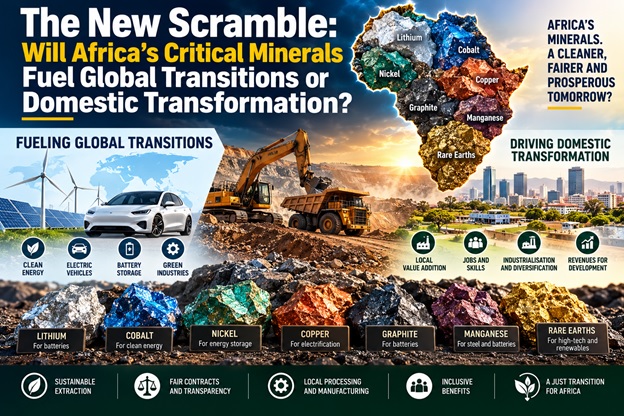
As the world races to decarbonise, the demand for these critical minerals has skyrocketed, sparking fierce global competition. Yet, for Africa and specifically for nations like Ghana, this global transition raises a profound existential question: Will we merely serve as the world's extraction site for green ambitions or will we leverage this moment for genuine domestic industrial transformation?
The new geopolitical currency
The worldwide competition for critical minerals is reshaping international relations at an unprecedented pace. The transition from fossil fuels to renewable energy systems—electric vehicles (EVs), solar panels, wind turbines, and advanced battery storage—is highly mineral-intensive. For instance, an electric vehicle requires six times the mineral inputs of a conventional car.
As a result, major global powers are locked in a strategic scramble to secure supply chains. The United States, the European Union, and China are deploying massive capital and diplomatic leverage to secure access to these resources.
This is no longer merely an environmental imperative; it is a matter of supreme national security and economic survival for the industrialised world.
However, this global rush often prioritises the rapid deployment of clean technologies in the Global North over the equitable development of the regions supplying the raw materials.
The prevailing international framework has largely focused on capital deployed primarily to reduce global carbon intensity and meet international climate targets. In this model, technology is deployed but not transferred; external investors retain value, and global climate targets, not local economies, are the primary beneficiaries.
Focus on Africa
Africa sits at the centre of this new geopolitical landscape, holding vast reserves of minerals essential to the energy transition. Yet, the continent faces a stark paradox: it possesses the wealth to power the future, but struggles with severe energy access and reliability challenges at home.
"The pattern is familiar. Large-scale capital is committed to energy transition projects... but the manufacturing base, the engineering skills, the component supply chains, and the long-term maintenance ecosystems remain predominantly external. Africa becomes a site of green energy deployment rather than a centre of green industrial production."
Three policy imperatives
To translate global green commitments into genuine domestic transformation, Ghana and its African peers must enforce three non-negotiable imperatives:
• Sequencing over Scale: We must anchor new green capacity commitments to prior reforms in distribution infrastructure and tariff cost-reflectivity. Renewable energy that cannot be efficiently transmitted, metered, and billed does not advance industrialisation; it merely advances national debt.
• Contractual Technology Transfer: Localisation cannot be a rhetorical assurance. It must be operationalised through specific project agreements, local content requirements, skills transfer schedules, and domestic maintenance obligations. We must reject turnkey installations that leave no knowledge behind.
• Institutional Agency: African institutions must be co-designers of project pipelines, not merely co-signatories to externally designed deal structures. Engagement with multilateral coalitions must be active and technically grounded.
Implications of the Africa Forward agenda
The Africa Forward Summit concluded a vital window of opportunity. The architecture for a more equitable Africa-Europe partnership on the energy transition has been drafted, but architecture is not implementation.
As an African proverb wisely notes, "The hunter who abandons the trail never reaches the game."
The trail ahead requires immense institutional discipline. African policymakers, energy-sector institutions, and regulatory bodies must engage with these global frameworks on terms that build lasting industrial capacity. We must demand Transformation Finance, not just Transition Finance. Only then can we ensure the global scramble for critical minerals fuels Africa's industrial renaissance, rather than becoming another milestone on a road of dependency still under construction.