


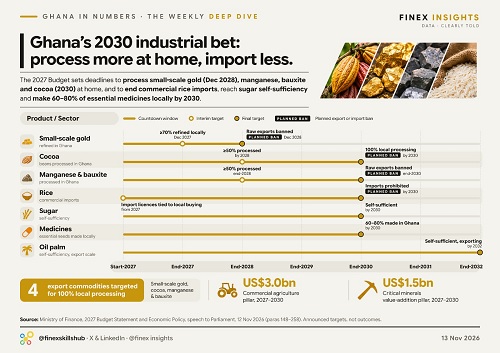
THE country will ban raw exports of key minerals and prohibit commercial rice imports by 2030 under an ambitious industrial policy contained in the 2027 budget aimed at capturing more value from domestic resources and reducing reliance on costly imports.
The country, which remains heavily dependent on raw commodity exports, plans to process 100 per cent of its cocoa, manganese and bauxite locally by the end of the decade, while achieving self-sufficiency in sugar and manufacturing of up to 80 per cent of its essential medicines.
For artisanal and small-scale gold — a major foreign exchange earner — the timeline is tighter. The government targets local refining for at least 70 per cent of output by December 2027, ahead of a total ban on raw exports by December 2028.
These are targets, not outcomes, but taken together they represent one of the country's most aggressive attempts in decades to overhaul an economy reliant on exporting raw materials and importing finished goods.
Narrow export base
Data from the Ghana Statistical Service highlight the vulnerability of the current model: gold bullion accounted for 62.9 per cent of merchandise export value in 2025, with cocoa beans contributing another 8.6 per cent.
To shift the value chain up, the government plans to invest $1.5 billion in critical-minerals processing —covering gold, manganese, bauxite and lithium.
In the cocoa sector, where the country targets 50 per cent local processing by 2028 before marching on to 100 per cent in 2030, the challenge is operational rather than infrastructural.
State regulator, Cocoa Marketing Board (COCOBOD), reported installed domestic grinding capacity of roughly 504,780 tonnes in 2025, yet factories operated at less than half capacity due to bean supply constraints, high financing costs and expensive power.
Closing import gap
On the import side, the government plans to choke off foreign competition gradually before imposing outright bans.
Starting from 2027, rice import licences will be tied to off-take agreements with verified local farmers and millers, with quotas tightening until commercial imports are outlawed in 2030.
Bridging the supply gap will require rapid scaling. Agriculture ministry data from October 2026 show domestic production meets just 56 per cent of demand, leaving Ghana to spend between $320 million and $500 million annually on rice imports.
While the ministry aims for self-sufficiency by 2028, the 2030 import ban builds in a two-year buffer for milling, storage and distribution networks to mature.
A similar push is planned for pharmaceuticals, where imports currently satisfy 70 per cent to 75 per cent of national demand at an annual cost of roughly $500 million.
The 2027 budget proposes a $1 billion Pharmaceutical and Biomanufacturing Compact to push local production of essential medicines to between 60 per cent and 80 per cent by 2030, backed by mandatory state procurement of locally made drugs that meet regulatory standards.
Palm oil
Oil palm has been granted a longer timeline to accommodate crop maturation cycles. Supported by a $500 million patient-finance facility and 100,000 hectares of new plantations, the government targets self-sufficiency and export scale by 2032 to erase an annual production deficit of roughly 150,000 tonnes.
While the legislative bans are designed to force domestic value addition, economists and industry analysts note that execution risks remain high.
Without reliable raw material supply, competitive industrial power tariffs, affordable credit and strict quality enforcement mandates alone risk creating supply bottlenecks rather than competitive local industries.
Ultimately, the success of the industrial wager will be measured not by the 2028, 2030 and 2032 deadlines, but by factory utilisation rates, export earnings and actual import savings when those dates arrive.
Structural shift, stability holds
Economist Professor Festus Ebo Turkson has described the 2027 Budget as a refreshing and purposeful attempt to structurally transform the Ghanaian economy, praising the government’s focus on macroeconomic stability, sharp reductions in interest rates and the decision to channel savings into productive investments rather than wasteful spending.
In a post-budget interview with the Graphic Business on Friday, November 13, the professor of economics said the budget presented by Finance Minister Cassiel Ato Forson marked the first time in many years that a government was deliberately allocating resources to specific projects aimed at changing the structure of the economy.
“I am excited that, for the first time in so many years, we are seeing a government that is actually devoting money to specific projects to transform the structure of the Ghanaian economy,” Prof. Turkson stated. “That is what we need to build resilience.”
He stated that the economy had faced three external shocks in the course of the year, yet the impact on the economy had been muted largely because of the macroeconomic stability currently being enjoyed. “At the centre of the resilience is macroeconomic stability,” he said.
Strong performance
Prof. Turkson highlighted that almost all the fiscal targets set by the government had been met. Inflation, he pointed out, had fallen below the lower bound of the target band, a development he described as “very refreshing.”
Interest rates have also dropped to levels not seen in years. Banks are currently lending at between 12 per cent and 12.5 per cent, compared with nearly 36 per cent only two to three years ago, with Treasury bill rates, which once hovered around 30 per cent, now standing at about 4.5 per cent for the 91-day.
“You can clearly see that the government is doing something about making sure that the private sector will grow,” he said. “In an economy where investors are borrowing at less than 10 per cent, it is reassuring because now they can get cheap credit. That also creates jobs.”
Cheaper credit for businesses, he argued, supports investment and job creation, reinforcing the private-sector foundation of the 24-hour economy agenda.
New Economy, 24-HR concept complementary
Responding to comparisons between the 24-hour economy and the 1-3-3 shift system, Prof. Turkson rejected the suggestion that the new economy policy meant the 24-Hour Economy has been abandoned.
He explained that the 24-hour economy was an enabling framework designed to support the private sector to produce around the clock, rather than a programme in which government itself directly creates three shifts.
“The government itself is not directly involved in the 24-hour economy as if it is part of the production environment. It is enabling the environment to allow the private sector to produce all around the clock so that it can increase employment,” he said.
The new economic concept, he added, is the broader framework under which government is directly investing in transforming the productive structure of the economy — in pharmaceuticals, textiles and garments, light manufacturing, agro-processing, commercial farming and tourism.
“The 24-hour economy is embedded within this larger structural transformation agenda; the two are complementary, not alternatives,” Prof. Turkson stated.
$10bn outlay realistic
On the realism of the approximately $10 billion capital outlay for the new economy over four years, Prof. Turkson said the Finance Minister had indicated that savings already made in 2026, together with further savings expected, would support annual spending of about $2.5 billion on structural transformation.
“That is very doable,” he said. “It only tells you that we have wasted money in the past. What is even surprising is the fact that Ghana is able to really save money to pay for the investments coming up in 2027. We are ahead of schedule. We don’t need to go outside to borrow money to develop the country.”
He argued that borrowing for productive expansion should not be a source of worry because it expands output, creates jobs and ultimately increases tax revenue. “You need to get people into jobs so you can tax them. That is how countries that have high tax revenue as a percentage of GDP do it.”
3-Shift production
Prof. Turkson emphasised that the three-shift system will emerge organically once the business environment becomes conducive and demand for locally produced goods rises. The government is already taking enabling steps, including tax rebates on solar imports to lower energy costs, selective import restrictions to create demand for domestic producers, and tax rebates on machinery imports.
“These are all the enablers for the three shifts a day. This is not going to happen overnight. It takes time,” he said, citing the multi-decade consistency of East Asian development experiences. “The fact that the economy is stable itself is a big, big push for those three shifts a day.”
While welcoming robust public criticism as healthy for democracy, Prof. Turkson insisted that the current trajectory is positive and relatively rare in recent Ghanaian history.
“There’s a lot of good things happening now, and we need to commend the government. If they don’t do it well, we’ll criticise. I’m always someone who will criticise when I have to and give the credit when I have to. I think what is going on currently is something that is refreshing. We’ve not seen that in a long time.”
Mixed bag
Development economist and Senior Lecturer at the University of Ghana, Dr Adu Owusu Sarkodie, however, described the 2027 budget as a mixed bag, praising its short-term fiscal discipline, while expressing serious reservations about the near-absence of the government’s flagship 24-hour economy and its much-touted 1-3-3 formula that formed the plank of the National Democratic Congress (NDC) campaign.
In a post-budget interview with the Graphic Business, Dr Adu Owusu Sarkodie, a researcher and Senior Lecturer at the Department of Economics, University of Ghana, said Ghanaians who voted the NDC into office for a four-year mandate expected the budget to give concrete expression to the 24-hour economy agenda, which was formally launched by President John Dramani Mahama.
He said under the 1-3-3 concept, one job was to be shared among three people working eight-hour shifts to create round-the-clock economic activity and triple the workforce.
“We look at the documents — the 24-hour economy documents, research for the 1-3-3 formula or framework — you won’t find it,” Dr Sarkodie stated.
“Out of 287 pages, 1-3-3 appears only once on page 18, which states that the 1-3-3 formula is a destination, economic transformation is a process, and therefore for Ghana to embark on 1-3-3, we must first transform the economy.”
The timeline given for that transformation, he pointed out, is 2030.
The economist argued that the newly unveiled “new economy” framework draws heavily on the 24-hour economy document but shifts emphasis to a public-sector-led approach, whereas the original blueprint was largely private-sector driven.
While public-private partnerships are welcome, he said the distinction raises questions about continuity.
“Ghanaians voted for them for a four-year mandate which ends in 2028. So how sure is the Finance Minister that their government will still be in power by 2030?” he asked. “If they are not in power by 2030 and a new administration decides not to continue, what happens to the new economy?” Dr Sarkodie asked.
He pointed out that the National Development Planning Commission (NDPC) had the constitutional mandate to produce medium-term frameworks that outlive individual governments.
A framework driven primarily by the Finance Ministry, Dr Sarkodie cautioned, lacked the same institutional permanence.
Thumbs up
He also welcomed key elements of the budget, particularly its short-term fiscal discipline, the deliberate increase in capital expenditure, the increased allocation to agriculture and the decision to prioritise cheaper domestic borrowing at a time of relatively low interest rates.
Dr Sarkodie said the government had taken several steps in the right direction which, if sustained, could support recovery and lay foundations for future growth.
“I was thrilled to see that it is going to increase capital expenditure,” Dr Sarkodie stated. “In fact, not only that, but the entire government machinery expenditure — compensation to employees, goods and services and social benefits.
“These expenditures are very good for government machinery to run. It will stimulate the economy and provide water, electricity and other public goods for the private sector to thrive on,” the economist pointed out.
“Majority of the money is going to agriculture, which is very good. We are just hoping that he will stay disciplined and deliver. If he does that, I think we are all with him.”
The economist further endorsed the broader priority areas identified in the budget — energy, minerals, tourism, textiles, pharmaceuticals and technology — describing them as “doable” with the extra funding envelope.
On the financing of that envelope, estimated at about GH¢30 billion for the coming year (part of roughly $10 billion over four years), he found the approach largely sound.
The extra resources are expected to come from three main sources: the lowering of the primary balance surplus target from 1.5 per cent of GDP to 0.5 per cent (creating about GH¢18 billion in fiscal space), intensified tax compliance and technology-driven reforms including the use of artificial intelligence (projected to yield GH¢9 billion), and the planned rebasing of GDP (about GH¢3 billion).
“I do not disagree with the minister at all,” Dr Sarkodie said. “If you have some relief after the International Monetary Fund (IMF) programme and can reduce the primary balance from 1.5 to 0.5 to give you one percentage point difference. That is the right thing to do.”
Gold reserves
Dr Sarkodie identified three areas under the macroeconomic stability pillar that require careful management: international reserves, the exchange rate and inflation.
On reserves, he welcomed accumulation but warned against over-reliance on gold purchases that may be linked to illegal mining.
“If the gold is from galamsey, then it is not sustainable. We just hope that the gold being used to develop reserves is not from galamsey — maybe from responsible mining. Going forward, the government should intensify the fight against galamsey,” Dr Sarkodie pointed out.