


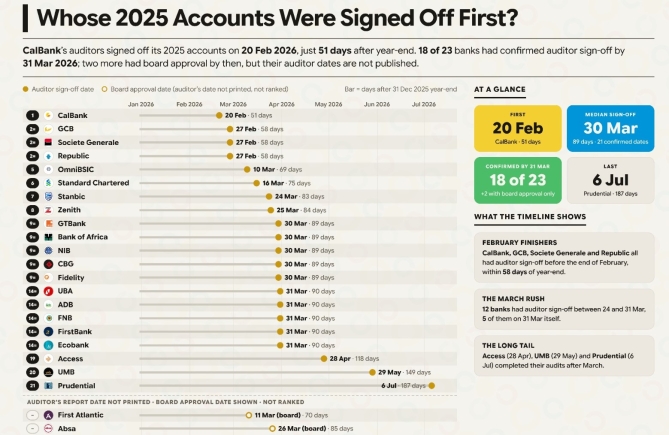
A review of the financial reporting timelines of 23 Ghanaian banks reveals a striking concentration of audit milestones in March 2026, with CalBank leading the field and three banks extending beyond the first quarter.
How quickly do Ghanaian banks complete the independent audit of their annual financial statements?
An analysis by Finex Insights of the FY2025 reporting calendars of 23 banks offers an interesting perspective on the pace of financial reporting across Ghana's banking industry.
The results reveal three distinct patterns: a small group of early finishers, a large concentration of banks completing their reporting milestones towards the end of March and a handful whose timelines extended considerably further.
However, these dates measure reporting milestones rather than the actual dates on which banks completed their internal accounting processes.
CalBank sets pace
CalBank recorded the earliest independently verified auditor sign-off date in the analysis, with its 2025 financial statements signed by Deloitte & Touche on February 20, 2026.
That was just 51 days after the financial year ended on December 31, 2025.
The GCB, Societe Generale and the Republic Bank followed in the dataset, each recording February 27, equivalent to 58 days after year-end.
Together, these four banks form the February group, completing their reported audit milestones well ahead of the concentration observed in March.
CalBank subsequently announced its audited financial results publicly on February 23, illustrating the distinction between completing an audit and releasing the results to stakeholders.
An early audit sign-off may reflect effective preparation, coordination and financial reporting processes. However, it does not independently establish that a bank has better financial controls or stronger financial performance than its competitors.
The March rush: A remarkable concentration
The most striking feature of the reporting calendar is the concentration of milestones towards the end of March.
Of the 23 banks reviewed, 13 had displayed reporting dates between March 24-31, 2026.
Five banks recorded March 30, while another five recorded March 31.
This means that 10 of the 23 banks had reporting milestones concentrated within just two calendar days.
Such clustering raises an interesting question: are banks completing their reporting processes at similar speeds, or are their schedules influenced by common regulatory, governance and reporting expectations?
The concentration is consistent with banks working towards a shared reporting period. However, the data alone cannot establish the reason for the clustering.
Audit completion depends on several factors, including the availability of financial information, external audit procedures, the resolution of accounting matters and the approval processes of individual institutions.
The median date across the 23 displayed reporting milestones was March 30, 2026, equivalent to 89 days after year-end.
There is an important qualification: for First Atlantic Bank and Absa, the dates shown represent board approvals because the auditor's report dates were not available in the underlying published documents.
Consequently, the median and March completion statistics should be interpreted as measures of the displayed reporting milestones, rather than a fully verified comparison of auditor sign-off dates for every bank.
This distinction matters because board approval, auditor sign-off and public publication are related but separate events.
Three banks form the long tail
Beyond March, only three banks remained in the reporting calendar.
Access Bank recorded a milestone on April 28, 118 days after year-end. UMB followed on May 29, 149 days after year-end, while Prudential Bank appeared last, with a date of July 6, 187 days after year-end.
The difference between the earliest and latest displayed dates was 136 days.
That is a substantial variation for institutions reporting on the same financial year.
Nevertheless, a later auditor sign-off should not automatically be interpreted as evidence of weak financial management, financial distress or regulatory noncompliance.
A meaningful assessment would require further information about each bank's reporting obligations, audit circumstances, accounting complexity and any relevant extensions or disclosures.
Why reporting timelines matter
Timely audited financial statements are important to shareholders, depositors, regulators and other stakeholders.
Audited accounts provide information about profitability, asset quality, capital, liquidity and other dimensions of financial performance.
The longer the interval between year-end and the availability of audited financial information, the older that information becomes for users making decisions.
However, speed is only one dimension of reporting quality. Accuracy, completeness, transparency and the reliability of the independent audit are equally important.
A bank that reports early does not necessarily have stronger financial fundamentals, just as a bank that reports later does not necessarily have weaker fundamentals.
What Ghana's banks can learn
The FY2025 reporting calendar provides a useful starting point for examining financial reporting efficiency in Ghana's banking sector.
It highlights CalBank's early completion, the pronounced concentration of reporting milestones in late March and the extended timelines recorded by three banks.
The next analytical step would be to compare these results with previous years, distinguish auditor sign-off from public publication dates, and examine whether reporting speed is consistent over time.
That would help establish whether the patterns observed in 2025 reflect persistent institutional differences or simply the circumstances of one reporting cycle.
Ultimately, the more important question is not merely which bank finished first, but which institutions consistently deliver timely, reliable and transparent financial information.